
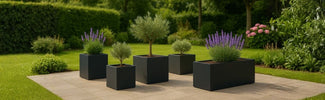
How to Choose the Right Planter Size for Your Garden or Patio
, 9 min reading time
, 9 min reading time
A well-chosen planter does more than support your plants — it also determines the look, the maintenance and the health of your planting. In this guide you'll discover, step by step, how to choose the perfect planter size for your garden, patio or balcony. We cover root depth, proportions, stability and water management, and provide practical guidelines with tables and examples. This way, you'll choose a size that supports both healthy plant growth and a well-maintained look, whether you have a city patio or a spacious garden.
The right size depends on three factors: plant size, root depth and available space. A planter that's too small restricts growth, dries out faster and can tip over. A planter that's too large can look visually too heavy and require unnecessarily large amounts of substrate. Choose a size that supports both the biological needs and the aesthetics of your outdoor space.
Rule of thumb for proportions: ideally, the (mature) plant height should be 1.5–3× the visible planter height. This keeps compositions balanced, and the overall look doesn't appear "top-heavy".
| Size category | Guideline depth | Advantages | Disadvantages |
|---|---|---|---|
| Small (up to 40 cm) | 20–30 cm | Light, movable, budget-friendly, ideal for seasonal planting or herbs. | Dries out faster, limited root space, less wind stability. |
| Medium (40–60 cm) | 40–60 cm | Good balance between volume and stability; suitable for ornamental grasses, perennials, compact shrubs. | Limited mobility; requires somewhat more substrate and load capacity from the patio. |
| Large (60 cm+) | 70 cm+ | Suitable for shrubs or small trees, strong visual impact, more moisture buffer. | Fixed placement, heavier weight, larger initial fill. |
The 60 × 60 × 60 cm planter is perfect for medium-sized perennials or compact shrubs. This size offers sufficient root volume without being too dominant on an average patio. Ideal for ornamental grasses, lavender or low shrubs in a modern setting.
The 100 × 40 × 40 cm planter is ideal for linear planting, such as lavender, grasses or herb mixes. Thanks to its elongated shape, you can create a clean line along walls or garden paths and add structure to modern outdoor spaces.
The 80 × 80 × 80 cm planter offers plenty of depth and stability, ideal for plants with strong root growth such as olive trees, ornamental crab apples or compact bamboo varieties. This size works excellently as a visual focal point on a patio or in the garden.
The 120 × 40 × 50 cm planter combines length and height, making it ideal for use as a natural screen. Perfect for multi-stemmed shrubs, ornamental grasses or small hedge structures. Combine several planters for a green wall that provides privacy and wind protection.
The 150 × 50 × 60 cm planter is the ideal size for generous planting and spacious areas. Thanks to the extra height of 60 cm, this planter offers sufficient root volume for larger shrubs or combinations of ornamental grasses. An elegant choice for corporate gardens, roof gardens or spacious private patios.
For herbs and annuals, a planter with a depth of 20 to 30 cm is sufficient, as these plants have a less deep root system.
For shrubs and small trees, a depth and width of at least 70 cm is recommended, so there's enough space for strong root growth.
Yes, a smaller planter is lighter and therefore more prone to tipping over, especially when combined with taller planting. A larger or heavier size, possibly with extra weight added at the bottom, offers more stability on windy balconies or roof gardens.
Apply a drainage layer of 5 to 10 cm of expanded clay pellets, possibly supplemented with root fabric, to prevent substrate from clogging the drainage holes.
This depends on the material and the planting: frost-resistant materials can generally stay in place, but during frost, check that water can drain properly from the planter, as frozen, trapped water can damage it.
At Doika you'll find planters in various materials and sizes, from compact models for herbs to XL versions for large shrubs or trees, carefully selected for quality, weather resistance and finish. Customers rate Doika 4,3/5 on Trustpilot, and you benefit from fast delivery, clear product information, warranty against manufacturing defects, and accessible customer service that helps you with questions about the right size, placement or maintenance.
Choosing the right planter size is a combination of practical knowledge and visual balance. By taking plant type, space, drainage and proportions into account, you create a durable and stylish outdoor space. Looking for the right size for your garden or patio? Browse all planters at Doika and find the size that suits you.


