
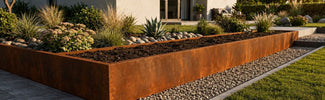
When do you need a retaining wall in your garden?
, 14 min reading time
, 14 min reading time
A difference in height in the garden becomes a practical consideration as soon as soil needs to be retained or different garden levels need to be clearly separated. This applies, for example, to a sloping garden, a raised flower bed, an embankment or a terrace that sits lower than the lawn. In this guide, you will discover when a retaining wall becomes genuinely functional, which situations require a retaining solution and which factors are important when choosing one. First, we determine whether a retaining wall is necessary. Then we look at which type of design may suit the shape, load and structure of your garden.
A retaining wall is a structure that holds back soil or a difference in height between two garden levels. It is used when a higher soil level must not move freely toward a lower area, for example between a lawn and terrace, around a raised flower bed or along an embankment. The main difference from a standard edging is its function: edging mainly separates materials, while a retaining wall must actually hold back soil.
A retaining wall becomes especially relevant when a difference in height means that soil needs to be held back. Therefore, do not only look at the visible height, but mainly at the function of the separation. If it only needs to separate two materials, a simple edging may be sufficient. If it needs to support a higher soil level, the structure takes on a retaining function.
If the lawn, for example, is higher than the terrace, the transition cannot always be solved with simple edging. If the higher section contains soil that needs to stay in place, the separation takes on a retaining function.
Take into account the difference in level, the length of the section, the local soil conditions and the load from the higher area.
A raised flower bed contains soil that is kept above the surrounding garden level. The outer edge therefore not only determines the shape of the bed, but must also keep the soil within the raised area.
For a design with corners, a specific corner version may be relevant to follow the retaining wall layout correctly.
An embankment creates a natural transition between different heights. If you want to define part of that slope or need to retain soil locally, a retaining wall can form part of the solution.
Not every embankment automatically requires a retaining wall. The shape of the terrain, the soil, the load and the desired garden layout all help determine whether a retaining structure is necessary.
A terrace, lawn, gravel area, planting border and garden path can all be installed at different heights. A retaining wall can physically separate these zones when soil needs to be retained in addition to creating a transition between materials.
The clearest difference between decorative edging and a retaining wall is the load. A low edge may be sufficient when grass and gravel are almost at the same level. As soon as a higher mass of soil presses against the separation, the element takes on a true retaining function.
There is no universal height at which a retaining wall automatically becomes necessary. Soil, terrain structure, water, load, length and design all play a role. For larger differences in height, complex soil conditions or situations where stability and safety are important, a project-specific professional assessment is recommended.
This Fronta version is designed for applications where a difference in height needs to be accommodated or soil at a higher level needs to be retained. With nine available sizes, the version can be matched to the dimensions required by the project.
This version is specifically designed as an inner corner and is therefore relevant where two retaining sections meet at a corner. It can be used for raised flower beds, garden zones, embankment reinforcement and transitions between gravel, lawn and terrace.
This Fronta version is also intended for accommodating differences in height and resisting pressure from higher soil or water. The main verified difference within the available information is that this version is available in twelve sizes.
This version suits projects where a difference in height or a higher soil level needs to be retained and one of the nine available sizes matches the intended garden structure. Always check the required dimensions and load of the project.
This version suits a design where two sections of the retaining wall meet at an inner corner, for example around a raised garden zone or at a corner in an embankment. The fixed configuration of 50 × 50 × 75 cm must match the planned layout.
This version suits projects where soil needs to be retained and a suitable size is required within the twelve available formats. Without additional product information, no other technical differences from the Fronta version with nine sizes are assumed.
| Model | Best application | Suitable for | Key difference |
|---|---|---|---|
| Fronta Corten Steel — 9 sizes | Differences in height and retaining soil | Projects matching 9 sizes | 9 available sizes |
| Fronta inner corner 50x50x75 cm | Inner corners and raised zones | Projects with an inner corner | Specific corner configuration |
| Fronta Corten Steel — 12 sizes | Differences in height and retaining soil | Projects matching 12 sizes | 12 available sizes |
The right version is determined by the function of the wall, the shape of the terrain and the load it needs to withstand. Check the following points before choosing a size or version.
A retaining wall is useful when soil at a higher level needs to be held back or when different garden levels need to be functionally separated. This may apply to a sloping garden, a raised flower bed, an embankment or a transition between lawn and terrace.
Yes. Retaining walls are designed to accommodate differences in height and can hold back soil from a higher garden area. The suitable version depends on the dimensions, load, soil context and project structure.
Yes. A retaining wall can keep the soil of a raised flower bed or another raised garden zone in place. If the design includes an inner corner, a specific corner version may be relevant.
Professional advice is recommended when the situation becomes structural or safety-sensitive, for example with complex differences in height, significant loads or difficult soil and water conditions. In such cases, the complete project structure should be assessed, not just the selected retaining wall element.
At Doika, you will find retaining walls in different versions and sizes for applications such as differences in height, raised garden zones, embankments and corner configurations. The product information helps you compare characteristics such as size, configuration, material and possible applications. Customers rate Doika 4.5/5 on Trustpilot, and you benefit from fast delivery, clear product information, a warranty against manufacturing defects and accessible customer service. If you have questions about the right version, size, placement or application, Doika can help you better match the available options to your project.
A retaining wall is the right choice when a difference in height means that soil needs to be held back, for example along an embankment, raised flower bed or another garden level. First determine the function, load, layout and dimensions. Then view the retaining walls at Doika and compare the Fronta with 9 sizes, Fronta inner corner 50x50x75 cm and Fronta with 12 sizes.


