
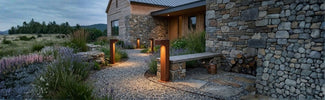
Most Common Mistakes with Outdoor Lighting — and How to Avoid Them
, 8 min reading time
, 8 min reading time
Installing outdoor lighting may seem straightforward, but mistakes occur more often than expected. Incorrect IP ratings, unsuitable materials, improper dimensions, or choosing the wrong fixture for the wrong project can lead to visible and costly consequences. In this article, Doika discusses the most common mistakes made with outdoor lamps, grouped by category and paired with practical solutions. This helps you choose outdoor lighting that performs reliably for years.
Outdoor lighting includes all fixtures designed for exterior use, such as wall lights, post lights, ground spotlights, and facade lighting. These fixtures are exposed to rain, frost, and UV radiation and must meet specific standards for water resistance and material quality that do not apply to indoor lighting. Outdoor lighting serves safety, atmosphere, and orientation purposes—and requires more expertise than most people realize.
Advantages:
Disadvantages and points of attention:
Many buyers choose an indoor fixture or a lamp with an IP rating that is too low. Water can penetrate the housing and damage the electronics. Use at least IP44 for covered areas and IP65 for fully exposed locations such as an open garden or driveway.
| IP Rating | Protection | Application |
|---|---|---|
| IP44 | Protection against splashing water from all directions | Covered patio, carport |
| IP54 | Dust protection and splash resistance | Facade, entrance area |
| IP65 | Protection against water jets | Open garden, driveway, outdoor post light |
| IP67 | Temporary immersion protection | Ground spotlights, pond edges |
Loose extension cables outdoors are unsafe and not designed for weather exposure. Permanent outdoor lighting should be installed by a qualified electrician using IP-certified cables and junction boxes. Solar outdoor lights offer a practical alternative where no electrical connection is available.
Cheap outdoor lamps often feature poor seals, fading LED modules, and housings that deteriorate after a short period of use. Always choose CE-certified outdoor lighting—the higher initial investment results in fewer replacements and lower maintenance costs.
Low-cost galvanized steel can begin to rust quickly. Plastic may yellow due to UV exposure. In demanding outdoor conditions, untreated aluminium can also become vulnerable. Powder-coated aluminium or stainless steel are ideal for standard applications, while anodized aluminium or marine-grade stainless steel are better suited to harsher environments.
Cool white light (6000K+) creates an industrial appearance that often feels out of place in residential settings and can make natural materials such as wood or stone appear less attractive. Choose 2700–3000K for warm and inviting outdoor lighting and use 4000K primarily for functional areas such as parking spaces.
A small wall light on a large facade can appear visually insignificant. An oversized fixture on a narrow doorway may look disproportionate. Wall lights for entrances should ideally be mounted between 2.2 and 2.5 metres high—too low causes glare, while too high reduces effectiveness. Match lumen output to the area: at least 10 lm/m² for orientation and 20–30 lm/m² for functional spaces.
A single lamp above the front door is rarely sufficient for a complete outdoor area. Dark zones along pathways, garages, or side entrances present safety concerns. Plan for at least three lighting zones: orientation (paths), accent lighting (facades, trees), and security lighting (entrances, driveways).
An unshielded outdoor lamp positioned at eye level can create discomfort for passers-by and nearby residents. Choose directional fixtures with glare protection and always direct the light downward or sideways.
Decorative outdoor lights intended for residential use are generally not designed for intensive use in apartment buildings or shared developments. For these projects, choose fixtures with an IK impact rating, a minimum IP65 rating, and extended warranty coverage.
An industrial lamp on a traditional property or a decorative fixture at a security-sensitive entrance creates a mismatch between appearance and function. Select lighting that complements both the architectural style and the intended purpose, while ensuring the number of fixtures suits the scale of the project.
Overly sensitive motion sensors may react to animals or moving branches. Sensors that are not sensitive enough can cause delays when entering an area. Adjust sensitivity and detection range after installation and test performance under different lighting conditions.
Dirty fixtures produce less light, deteriorated seals can allow water ingress, and ageing LEDs may suffer colour shifts. Clean outdoor lighting twice a year and inspect seals annually.
| Category | Mistake | Consequence | Solution |
|---|---|---|---|
| Technical | Incorrect IP rating | Water damage, short circuits | Minimum IP44, IP65 outdoors |
| Technical | Poor wiring | Fire risk, system failure | Qualified electrician, IP-rated cable |
| Technical | Low quality products | Rapid deterioration | Buy CE-certified fixtures |
| Material | Unsuitable material | Rust, fading, damage | Powder-coated aluminium or stainless steel |
| Material | Incorrect light colour | Cold, unpleasant atmosphere | 2700–3000K for residential use |
| Sizing | Incorrect size and height | Glare or ineffective lighting | 2.2–2.5 m height, adjust lumen output |
| Sizing | Too few light sources | Dark areas, safety concerns | Minimum 3 lighting zones |
| Project/Building Type | Residential fixture for shared use | Premature wear | IK-rated, professional IP65 fixtures |
| Project/Building Type | Incorrect style or scale | Functional mismatch | Combine style and function |
| Maintenance | No maintenance | Dirt buildup, leaks, failures | Clean twice yearly |
IP44 is suitable for covered areas such as canopies or carports. Choose IP65 for outdoor lighting in open gardens, driveways, or along pathways. IP67 is suitable for ground spotlights or locations close to water.
No. Indoor lamps do not provide the water resistance required for outdoor use and may cause short circuits, failures, or fire hazards. Always use certified outdoor lighting.
For outdoor lights producing 200–400 lumens, a spacing of 3 to 5 metres is generally recommended. Test the distribution of the outdoor lighting before final installation.
Select fixtures with an IK impact rating, a minimum IP65 rating, and a durable housing made from stainless steel or anodized aluminium. Decorative outdoor lamps designed for residential use are generally unsuitable for intensive communal applications.
A quality LED outdoor light can achieve 25,000 to 50,000 operating hours. At 8 hours of daily use, this equates to approximately 8 to 17 years. Low-cost outdoor lamps often achieve only 2,000 to 5,000 hours.
Doika specialises in premium outdoor lighting for homes, gardens, and commercial projects. Every fixture in the collection is selected according to the key criteria covered in this article: the correct IP rating, suitable materials for the intended environment, and proven durability. This means you do not need to determine for yourself whether a lamp is suitable for outdoor use—Doika has already done that work for you. Doika provides reliable service, transparent warranty conditions, straightforward returns, and expert support for both residential and professional projects.
Incorrect IP ratings, unsuitable materials, too few light sources, or choosing the wrong fixture for the wrong project—most outdoor lighting mistakes can be avoided with the right knowledge before purchasing. Always make your decision based on the location, project type, and technical requirements. Explore the complete range of certified outdoor lighting at Doika and choose outdoor lamps that perform reliably from day one—and continue to do so for many years.


